The surface treatment of metal insert injection molds is critical to product bonding quality, mold service life, and mass production stability. It directly impacts the bonding strength between metal inserts and plastics, the wear/corrosion resistance of mold cavities, and molding consistency. In practice, scientific surface treatment significantly improves insert-plastic bonding strength and extends mold life by 2-3 times. For test spline molds, precise surface treatment is essential to ensure test data reliability and accurate mass production process transfer. This article focuses on practical needs, explaining core processes, test spline mold requirements, and technical trends for industrial reference.
Core Objectives: Enhance mold cavity wear/corrosion resistance against molten plastic erosion; optimize surface microstructure to improve mechanical bonding between plastics and inserts, preventing peeling/cracking; ensure surface precision and consistency for repeatable test data and stable mass production. Test spline molds must simulate mass production conditions, as their treatment directly affects material compatibility and bonding strength evaluation.
Technical Standards: Industry-recognized criteria include surface roughness Ra (0.8-2.5μm, adjustable by plastic type), adhesion grade ≥5B (cross-cut test), wear resistance for over 10,000 injection cycles (no obvious scratches), and corrosion resistance (neutral salt spray test ≥48 hours, no rust). Test spline mold surface treatment consistency error must stay within a reasonable range for valid batch comparison.
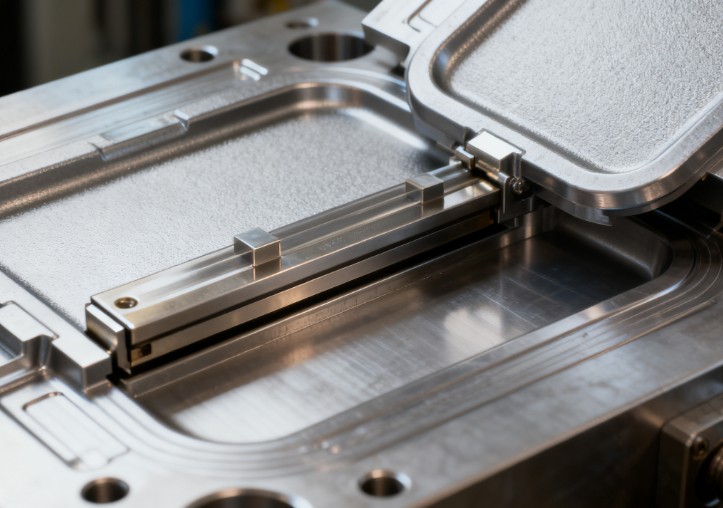
Sandblasting: Uses white corundum abrasive grains to form a uniform uneven surface via controlled spray pressure, increasing Ra to 1.2-2.0μm for better mechanical bonding. Test spline mold cavities require secondary sandblasting to ensure uniform texture and stable test data.
Knurling and Grooving: Optimizes knurling modulus and groove dimensions for insert contact areas, enhancing plastic-insert mechanical interlocking. Suitable for high-stress components in automotive/electronics industries.
Polishing: Uses diamond paste for mirror finishing (Ra ≤0.8μm), ideal for transparent plastics or medical products with high surface requirements, preventing flow marks and burrs.
Phosphating: A common anti-rust process. Immersing molds in zinc phosphate solution forms a uniform phosphating film (adhesion grade 5B) with neutral salt spray resistance ≥72 hours, suitable for humid environments or corrosive plastics.
Silane Coupling Agent Treatment: Key for verifying material compatibility in test spline molds. A 1%-3% mass fraction silane solution (via dipping/spraying) forms chemical bridges between metals and plastics, boosting bonding strength.
Electroless Nickel Plating: Deposits a layer with HV600-800 hardness, offering excellent wear resistance. Suitable for glass fiber-reinforced plastic molds to extend service life.
Plasma Treatment: Activates surfaces with argon/oxygen plasma, reducing contact angle and improving plastic-metal wetting without chemical residue. Suitable for medical-grade molds.
Physical Vapor Deposition (PVD): Deposits TiN/CrN hard coatings via magnetron sputtering (HV2000-3000), with 5-8 times higher wear resistance than traditional treatments. Ideal for high-speed mass production; applied to test spline molds to reduce surface wear impact on data.
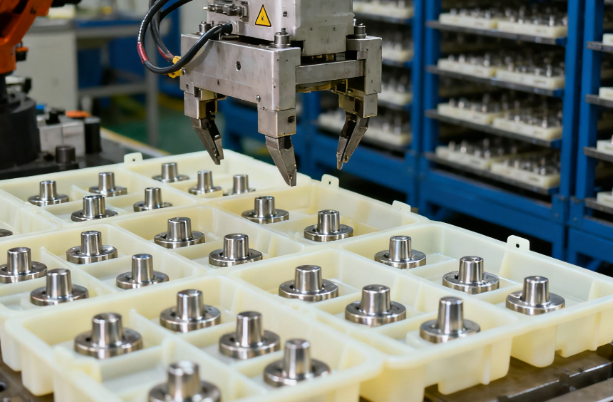
Core Principles: Prioritize surface consistency > bonding adaptability > wear resistance > corrosion resistance, centered on "simulating mass production and ensuring test validity." Cavity treatment parameters must match mass production molds to avoid process misjudgment.
Process Selection: Match material combinations (glass fiber-reinforced plastics + brass inserts: sandblasting + silane treatment; special engineering plastics + stainless steel inserts: plasma + PVD). Adjust roughness (1.5-2.0μm for bonding strength tests, 0.8-1.2μm for dimensional stability). Unify parameters for the same test mold set to ensure data repeatability.
Parameter Control: Cavity Ra controlled within ±0.1μm (multi-point roughness tester inspection); coating adhesion ≥5B (no peeling in cross-cut tests); surface roughness change remains reasonable after 1,000+ injections, with no obvious wear/corrosion.
Parameter Optimization: Adjust parameters by material characteristics. For stainless steel + polyolefin, match silane concentration and treatment temperature; for aluminum alloy + ABS, reduce sandblasting pressure to avoid insert damage.
Verification Indicators: Shear bonding strength complies with GB/T 1040.3-2006; no mold sticking on splines; no bonding cracking after multiple thermal aging cycles.
Mass Production Transfer: Maintain consistent equipment, parameters, and testing standards. Conduct first-article bonding strength tests; proceed with mass production only if deviation from test spline data is within a reasonable range.
Large Test Data Fluctuations: Caused by uneven treatment or excessive roughness deviation. Optimize parameters (constant-speed sandblasting, more inspection points, same-batch treatment fluids).
Mold Sticking and Spline Deformation: Due to insufficient roughness or poor compatibility. Increase Ra to 1.2-1.5μm, add plasma treatment, or use controlled mold release agent.
Severe Long-Term Wear: Resulting from insufficient wear resistance. Add PVD coating after basic treatment to improve hardness and extend service life to 5,000+ cycles.
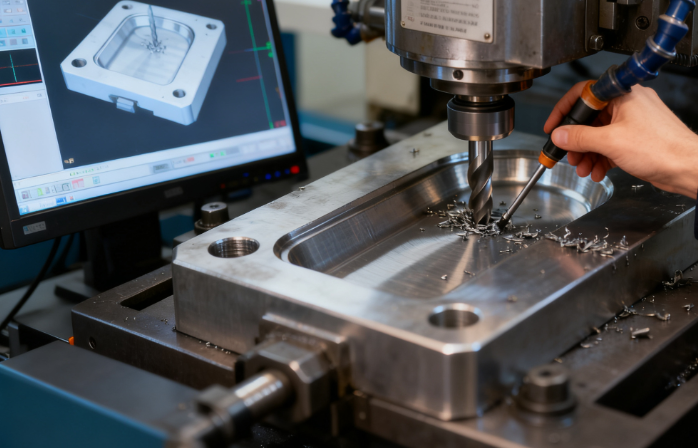
Surface treatment is evolving toward precision, environmental friendliness, and intelligence. Digitally, CAE simulation predicts treatment impact on bonding strength, reducing test spline runs. Environmentally, chromium-free phosphating and water-based silane agents replace traditional chemical treatments to cut emissions. Intelligently, online detection (laser roughness meters) monitors surfaces in real time, with algorithms adjusting parameters for batch consistency. Composite processes (e.g., sandblasting + plasma + PVD) are widely used to balance bonding strength, wear resistance, and corrosion resistance for high-end manufacturing.
Surface treatment is critical to metal insert injection mold performance, and test spline mold treatment directly determines process feasibility and test validity. In practice, select processes based on material combinations, test needs, and mass production conditions. Strictly control key parameters (roughness, adhesion) and verify via test splines before mass production transfer. Future integration of digital, environmental, and intelligent technologies will make surface treatment more precise, efficient, and green, supporting metal insert injection technology in high-end manufacturing.