In modern injection molding production, mold defects are common industry pain points, leading to high product defect rates, material waste, and production downtime. Industry statistics show that the first trial pass rate of molds without mold flow analysis (MFA) optimization is only 40%-50%, while common defects reduce production efficiency by over 30%. Based on computational fluid dynamics (CFD) and thermodynamics principles, MFA accurately simulates the entire process of plastic melt flow in mold cavities, providing scientific basis for mold design and process adjustment. Coupon test molds serve as key carriers to verify analysis results, and their combination forms the core defect control system.
Typical defects include flash, short shot, bubbles, warpage, weld lines, and sink marks. Flash occurs in 60% of thin-wall products, weld lines are common in complex-cavity products, and warpage is prominent in engineering plastic products such as ABS and PC. These defects cause significant losses: flash leads to a rework rate of 15%-20% (3-5 minutes per unit), short shots result in 8%-12% material waste, and warpage causes scrap rates up to 25%. Additionally, mold downtime for defect handling accounts for 20%-25% of total production time, severely restricting capacity.
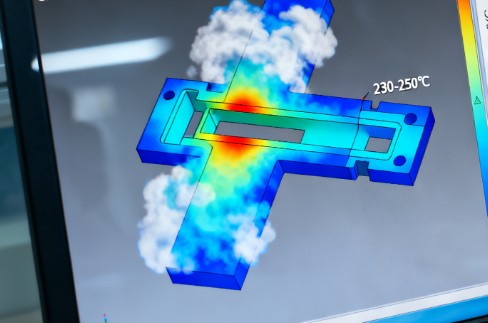
MFA establishes 3D mold models and plastic material databases to simulate the entire process from melt injection to cooling and solidification. It uses numerical calculations to reproduce temperature, pressure, and velocity field distributions, predicting defect locations and causes.
Core indicators include filling time (variation ≤ ±0.3s), pressure distribution (maximum cavity pressure ≤ 85% of mold allowable pressure, typically 150-200MPa for engineering plastic molds), temperature distribution (uniformity error ≤ 5℃), shear rate (1000-5000s?1), and solidification time (70%-80% of total cooling time).
Position: Set at the farthest melt flow point or thickest wall section of the cavity, avoiding key stress-bearing areas. 1-2 gates are usually used for single-cavity products.
Size: Calculated based on material fluidity and product weight. For PP materials, gate diameter ranges from 0.8-1.2mm for small products and 1.5-2.5mm for large products.
Layout: Prioritize balanced layouts to ensure consistent melt flow distance and pressure loss across cavities (length variation ≤ 5%). Main runner diameter is 1-2mm larger than branch runners (4-8mm).
Size: Control pressure loss ≤ 30MPa and reduce filling time variation to ≤ 0.2s for multi-cavity molds.
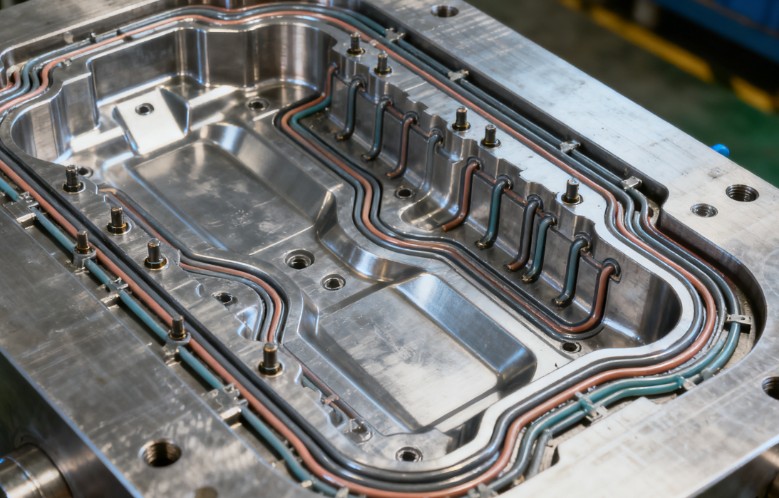
Circuit Design: Follow the "close to cavity, uniform distribution" principle. Water channels are 15-25mm from the cavity surface with 25-35mm spacing. Conformal channels are used for complex curved molds, improving cooling uniformity by over 40%.
Cooling Medium: Industrial cooling water (20-25℃, flow rate 1.5-2.5m/s) for general products; chilled water (5-10℃) for engineering plastics or thick-wall products (mold surface temperature fluctuation ≤ 3℃).
Injection Pressure and Speed: Injection pressure = 1.1-1.2×maximum cavity pressure. Adopt staged speed: 30-50mm/s (initial stage), 60-100mm/s (middle stage), 20-40mm/s (final stage).
Holding Pressure and Time: Holding pressure = 60%-80% of injection pressure. Time extends by 1-1.5s for each additional 1mm of product wall thickness.
Molding Temperature: Barrel temperature = plastic melting point + 20-40℃ (ABS: 200-240℃, PC: 260-300℃). Mold temperature: 40-80℃ (crystalline plastics), 60-120℃ (amorphous plastics).
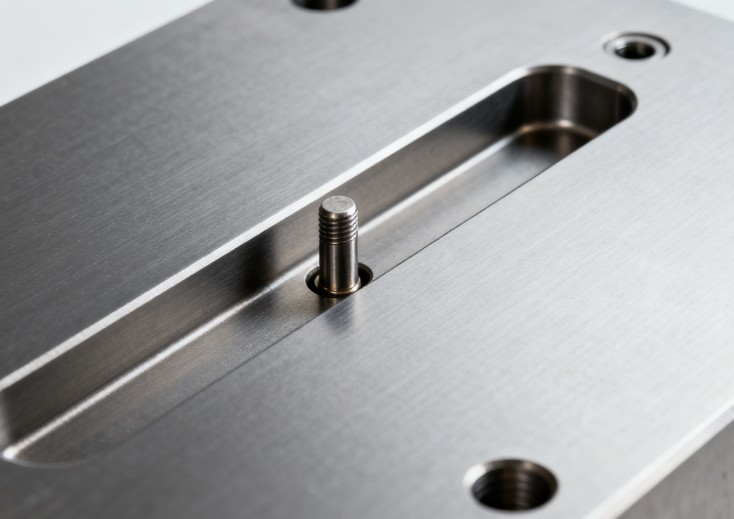
Standard molds for verifying MFA results, adopting ISO 527-2 standard tensile coupon dimensions (170mm×15mm×4mm). Available in single or multi-cavity designs with standard gates, runners, and cooling systems, they test material molding performance and data consistency.
Mold insert material: S136 or H13 tool steel (HRC50-55 after heat treatment).
Cavity surface roughness: Ra ≤ 0.8μm.
Ejection system: Ejector pins + ejector plate (pin diameter 2-3mm, spacing 30-40mm).
Temperature sensor mounting holes for real-time monitoring.
Calibrate MFA results by comparing simulation and actual data (error reduced to ±3% after adjustment). Verify process parameters, such as weld line strength under different injection speeds, to determine optimal process ranges.
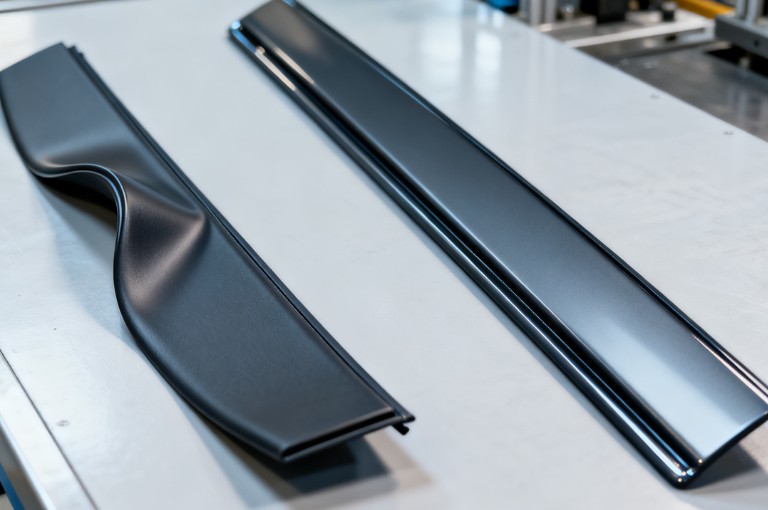
An enterprise producing ABS automotive door trim experienced severe weld lines and warpage (12% defect rate) during initial trials. MFA revealed that the single-gate design caused excessive melt flow distance, and uneven cooling channels led to an 8℃ cavity temperature difference.
Optimization measures: Added 1 auxiliary gate with balanced runners; adjusted cooling channel spacing to 30mm and added 2 conformal channels. Coupon tests showed weld line tensile strength increased from 18MPa to 25MPa, and warpage reduced from 0.8mm to 0.3mm.
Post-optimization results: Defect rate dropped to 2.5%, production efficiency increased by 28%, and material waste per batch decreased by 10%.
Intelligent development with AI algorithms automatically identifying design defects and optimization spaces. Big data enables model self-learning and calibration, reducing analysis time for complex molds by over 50% (to 10 minutes).
Enhanced coupling analysis of flow, temperature, and stress fields, simulating interactions between melt flow and mold deformation. Achieves full-chain digital verification from design to performance prediction.
MFA is the core technology for injection mold defect optimization, and coupon test molds improve optimization reliability. The closed-loop system of "MFA - coupon testing - mold optimization" significantly reduces defect rates, improves first trial pass rates, and drives the industry toward efficiency, precision, and intelligence—key to enhancing enterprise competitiveness.