Tensile Test Molds for Injection Molding Machines and Vulcanizing Machines Hoorenmold
As core tooling for material performance testing, tensile test molds directly determine the detection accuracy of key indicators such as tensile strength, flexural strength, and hardness of polymer materials like plastics and rubbers. Serving as a critical link between material R&D and mass production quality control, injection molding machine-specific and vulcanizing machine-specific tensile test molds exhibit significant differences in structural design, parameter settings, and application scenarios due to process adaptability. Both types strictly adhere to international and domestic standards to ensure the standardization and consistency of test specimen preparation. The following elaborates on their core technical characteristics, practical applications, and development trends.
I. Core Definitions and Application Scenarios
1. Tensile Test Molds for Injection Molding Machines
Adapted to injection molding processes, these molds are primarily used for preparing standard tensile specimens of thermoplastics, thermosetting materials, etc. Widely applied in material performance testing for automotive components, consumer electronics, aerospace, and other fields, they are designed to produce dumbbell-shaped specimens complying with ISO 527-2:2025 (Type A1 for direct injection molding or Type A2 for machining). These specimens support the testing of key material indicators including tensile strength and elongation at break.
2. Tensile Test Molds for Vulcanizing Machines
Specialized for vulcanization molding of rubber and elastomer materials, these molds work with compression molding machines and are mainly used in performance testing of rubber products such as automotive seals, medical infusion tubes, and new energy battery gaskets. Complying with GB/T 528-2009 (equivalent to ISO 37:2011), they produce Type A steel dumbbell specimens to accurately capture mechanical property changes during rubber vulcanization.
II. Core Technical Points of Structural Design
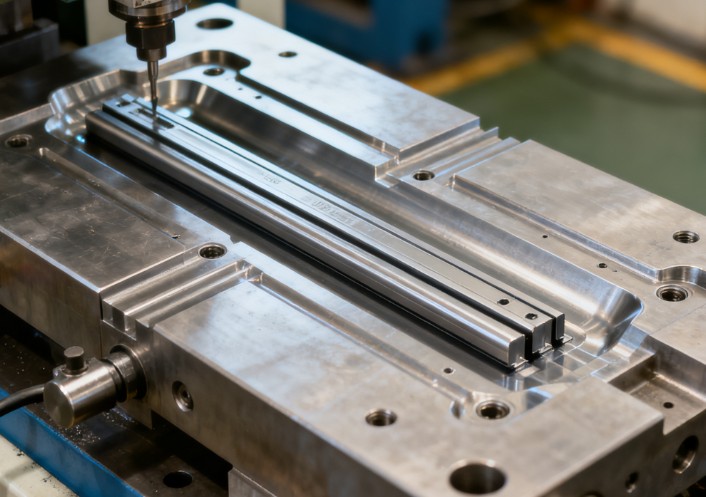
1. Tensile Test Molds for Injection Molding Machines
1.1 Cavity Design
Cavity quantity is determined by specimen precision and testing batch requirements: 4-6 cavities for high-precision (Class 3-3a) specimens, 8-12 cavities for general precision (Class 4-5) specimens, and up to 24-48 cavities for amorphous plastics. Cavity dimensions strictly follow standard specifications: Type A1 specimens have a gauge length of 75±0.5mm and initial grip separation of 115±1mm, with tolerance controlled within IT7 grade.
1.2 Auxiliary System Configuration
The gating system adopts a balanced runner design to ensure uniform cavity filling and minimize specimen dimensional deviations. The cooling system features custom water channel diameters, with inlet pressure maintained at 0.3MPa-1.0MPa and water temperature at 7℃-25℃ for uniform specimen cooling. Key mold components are made of S136H stainless steel or H13 tool steel, heat-treated to HRC 58-62 for extended service life.
2. Tensile Test Molds for Vulcanizing Machines
2.1 Cavity and Temperature Control
Adopting a rotorless oscillating cavity structure, these molds eliminate shear force interference from traditional rotor designs, reducing vulcanization time test deviation to within 3%. Heating holes are evenly spaced at 50-80mm, with temperature control precision of ±0.3℃, adapting to a wide vulcanization temperature range of 160℃-200℃ to meet the vulcanization characteristics of different rubber compounds.
2.2 Venting and Structural Optimization
Micro-scale venting grooves (0.03mm deep, approximately 1/100 of rubber thickness) reduce specimen porosity from 8% to below 1%, avoiding bubble-induced test data inaccuracies. The clamping area features a 15° wedge structure, reducing specimen slipping rate during tensile testing to within 0.5%. Transition arcs are designed with R5mm radii to minimize fracture distortion caused by stress concentration.
III. Manufacturing Process and Precision Control
1. Processing Standards
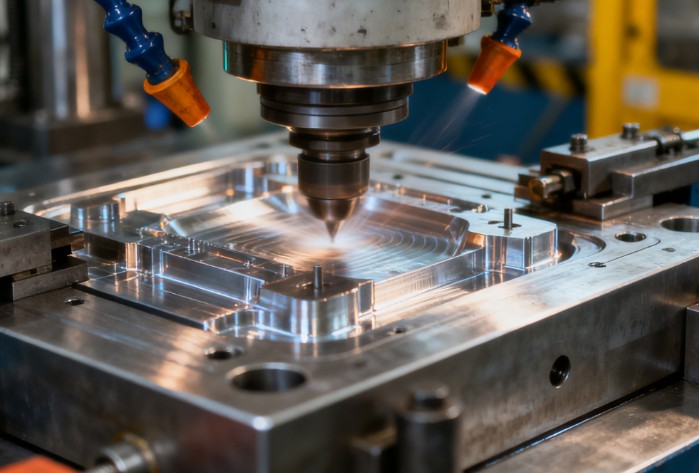
Both mold types adopt precision CNC milling and EDM technologies. Cavity surfaces undergo nitriding treatment followed by mirror polishing, achieving a roughness of Ra≤0.4μm to reduce specimen damage during demolding. Multi-cavity injection molds undergo runner balance testing before delivery to ensure consistent filling times across cavities. Vulcanizing molds require heating system uniformity calibration, with temperature fluctuation controlled within ±2℃.
2. Precision Inspection and Calibration
Cavity dimensions are fully inspected using coordinate measuring machines: injection mold cavity deviation ≤0.02mm, and vulcanizing mold specimen thickness deviation ≤0.05mm. Post-assembly trial production verification is mandatory, requiring a qualification rate of ≥99.7% for injection-molded specimens and a mechanical test data repeatability deviation of ≤2% for vulcanized specimens.
IV. Operational and Maintenance Guidelines
1. Daily Operation Points
Injection molds require hot runner system preheating to operating temperature within 1.5 hours (temperature deviation ≤±5℃). Vulcanizing molds are preheated to 20-30℃ below the vulcanization temperature to facilitate gas escape. Cavity residue cleaning and inspection of ejection and guiding mechanisms are mandatory before each production run.
2. Regular Maintenance Strategies
Clean runners and venting grooves daily after production; inspect cooling water channels and heating elements weekly. Conduct cavity dimension sampling calibration monthly and wear testing of key components after 10,000 cycles. Wear parts adopt an interchangeable design, and vulcanizing mold seals are regularly replaced to prevent vulcanizing agent leakage.
V. Technology Development Trends
1. Intelligent Upgrading
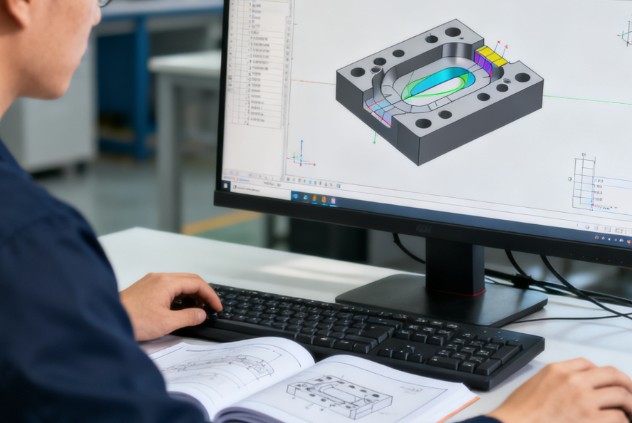
Molds are integrated with temperature and pressure sensors to collect real-time molding data, which is analyzed by AI systems to optimize process parameters. High-end molds feature remote monitoring modules for real-time operation tracking and predictive maintenance, reducing downtime.
2. Modularization and High Efficiency
Modular cavity designs support flexible switching between 2-16 cavities to meet varying testing batch requirements. New hot runner technologies shorten injection molding cycles, while vulcanizing molds use nano-amorphous silicon nitride coatings to double wear resistance.
3. Green and High-Precision Development
Environmentally friendly materials and energy-saving heating systems are adopted to reduce energy consumption and environmental impact. 3D printing technology is used for mold insert manufacturing, shortening development cycles and improving cavity precision to the micron level, meeting the refined testing needs of special materials.