Stainless steel spline test mold steel spline test mold Hoorenmold
1. Core Functions and Executive Standards
The stainless steel specimen test mold and mold steel specimen test mold are core tools for metal material performance testing, specifically designed to fabricate standard specimens for tensile, impact, and bending tests. Each is tailored to the unique properties of its target material—stainless steel and mold steel respectively. Their precision is critical to the reliability and comparability of test data, making them indispensable for material research and development as well as mass production quality control. These molds find wide applications in high-demand sectors such as aerospace, automotive manufacturing, and precision machinery. Both molds strictly adhere to international and domestic standards including ISO 6892 (Metallic Materials - Tensile Testing) and GB/T 228 (Metallic Materials - Tensile Testing at Room Temperature). Parameter adjustments are made based on the specific characteristics of each steel type to ensure that the dimensions and surface quality of the produced specimens meet rigorous testing requirements, providing a unified benchmark for material performance evaluation.
2. Design Specifications
2.1 Stainless Steel Specimen Test Mold
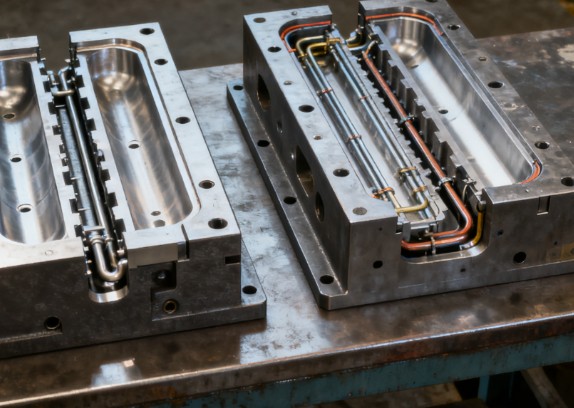
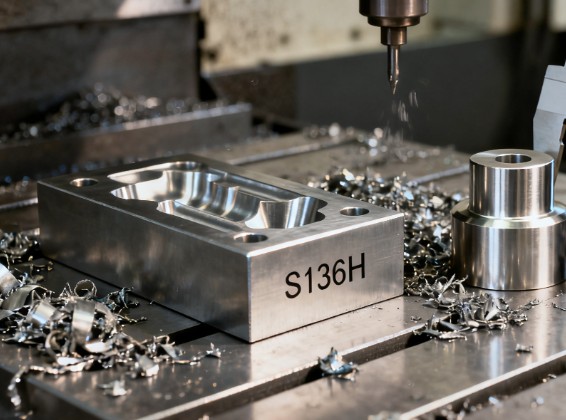
The mold’s core structure comprises a mold base, cavity, core, cooling system, and runner system. The mold base is preferably made of weather-resistant cast iron, while 6061 aluminum alloy is a viable option for small-to-medium batch testing scenarios to achieve lightweight design. The cavity and core, as key working components, are crafted from S136H stainless steel, chosen for its excellent corrosion resistance and polishability. After precision machining, their surfaces are polished to a mirror finish with a roughness of Ra≤0.2μm, minimizing surface defects on the stainless steel specimens and ensuring molding quality. For cavity design, single-cavity molds adopt a sub-gate structure to reduce gate marks that could affect specimen performance, with dimensional tolerance controlled within ±0.015mm—ideal for high-precision stainless steel R&D, such as for food-grade or medical-grade stainless steel. Multi-cavity molds are predominantly available in 4-cavity or 8-cavity configurations, featuring a balanced runner system to ensure uniform filling of molten stainless steel. Due to stainless steel’s low cooling shrinkage rate, cavity spacing is increased by 10%-15% compared to standard molds. High-end models offer modular switching between 2 to 16 cavities to accommodate large-scale testing needs. The cooling system is optimized for stainless steel’s low thermal conductivity, with runner diameters increased by 8%-10%. Computational Fluid Dynamics (CFD) simulations are used to ensure uniform cavity temperature, preventing specimen deformation from uneven cooling. The temperature control system maintains fluctuations within ±1.5℃, and the pressure control system within ±1%, guaranteeing stable molding and high precision.
2.2 Mold Steel Specimen Test Mold
This mold’s structure also includes a mold base, cavity, core, cooling system, and runner system, but with material adjustments to handle mold steel’s high strength and hardness. The mold base is constructed from HT300 high-strength gray cast iron for enhanced load-bearing capacity. The cavity and core are made of H13 tool steel, renowned for its excellent high-temperature strength and wear resistance. Their surfaces are polished to Ra≤0.3μm, and the cavity inner wall undergoes nitriding treatment to form a 0.15-0.2mm nitrided layer, improving durability against the high impact forces during mold steel molding. In cavity design, single-cavity molds use a pinpoint gate for easy demolding and reduced stress concentration, with dimensional tolerance controlled within ±0.02mm—suitable for small-batch testing of high-hardness mold steels like Cr12MoV. Multi-cavity molds are typically limited to 4 cavities to avoid overloading the mold base due to mold steel’s high molding pressure. A symmetrical runner system ensures uniform filling, with runner surfaces polished to Ra≤0.8μm to reduce flow resistance. Cavity spacing is 20% larger than that of stainless steel specimen test molds to adapt to higher molding pressures. The cooling system features multiple parallel runners spaced 15-20mm apart, tailored to mold steel’s high thermal conductivity and molding temperature. CFD simulations ensure uniform cooling, preventing cracks from rapid cooling. The temperature control system allows fluctuations within ±2℃, and the pressure control system includes a high-pressure compensation function with a maximum pressure of 180MPa, ensuring stable molding.
3. Manufacturing, Operation, and Maintenance
3.1 Stainless Steel Specimen Test Mold
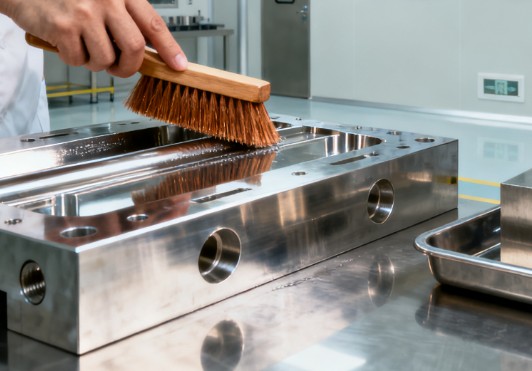
Key components such as the cavity and core are machined using five-axis CNC machining centers, achieving a machining precision of ±0.005mm. After polishing, the cavity undergoes passivation treatment using a nitric-hydrofluoric acid mixture to enhance corrosion resistance. Before leaving the factory, the mold undergoes 50 consecutive molding tests to ensure specimen dimensional deviation is within ±0.01mm. For operation, stainless steel raw materials are pickled with a 10% nitric acid solution for rust removal and precisely cut to ensure impurity-free surfaces and uniform dimensions. Molding parameters are set to 180-220℃ and 120-150MPa to match stainless steel’s molding characteristics. Daily maintenance involves cleaning residual stainless steel debris from the cavity using a soft copper brush to avoid scratches. Weekly checks of the cooling system’s patency and monthly calibration of the temperature control system are required. If the mold is inactive for over 72 hours, a special anti-rust oil for 304 stainless steel is applied to the cavity to extend service life.
3.2 Mold Steel Specimen Test Mold
The cavity and core are machined using high-speed CNC milling machines, followed by heat treatment including quenching at 1020-1050℃ and tempering at 580-620℃ to achieve a hardness of HRC 58-62. After nitriding, the cavity undergoes precision grinding to a precision of ±0.008mm. Factory testing includes 30 consecutive molding tests to ensure specimen dimensional deviation is within ±0.02mm. Operational procedures involve sandblasting raw materials with 80-100 mesh sand for rust removal. High-carbon mold steel (e.g., H13 steel with 0.3%-0.45% carbon content) requires preheating at 600-800℃ to reduce molding stress. Molding parameters are set to 220-250℃ and 150-180MPa to accommodate mold steel’s high hardness. Maintenance includes daily cleaning of residual debris using a cemented carbide scraper, weekly checks of cooling system pressure (maintained at 0.4-0.6MPa), and monthly calibration of the pressure control system. For inactivity exceeding 48 hours, high-temperature anti-rust oil (resistant to 200℃) is applied to prevent cavity rust.
4. Technical Trends
4.1 Stainless Steel Specimen Test Mold
Future developments focus on improving corrosion resistance and reducing weight. 3D printing technology is used to manufacture special-shaped cooling channel cores, eliminating cooling dead zones and enhancing cooling uniformity. IoT technology enables real-time monitoring of cavity corrosion status, reducing maintenance costs. Parametric modeling optimizes cavity structure, reducing steel usage by 12%-15% in line with green manufacturing trends.
4.2 Mold Steel Specimen Test Mold
Advancements center on boosting strength and intelligence. Powder metallurgy is employed to produce cavities, increasing hardness to HRC 63-65 and extending service life by 30%. AI algorithms analyze molding data to automatically adjust temperature and pressure parameters, improving specimen precision. A full-life-cycle management system leverages big data to predict replacement cycles for vulnerable parts, reducing mold testing costs by 25%.