Analysis of Material Selection and Advantages/Disadvantages for Custom Plastic Products
Introduction
Material selection is crucial in custom plastic product manufacturing, directly determining product quality, service life, and
application scenarios. This article analyzes the pros and cons of common plastic materials to guide material choice.
Common Plastic Materials and Their Advantages/Disadvantages
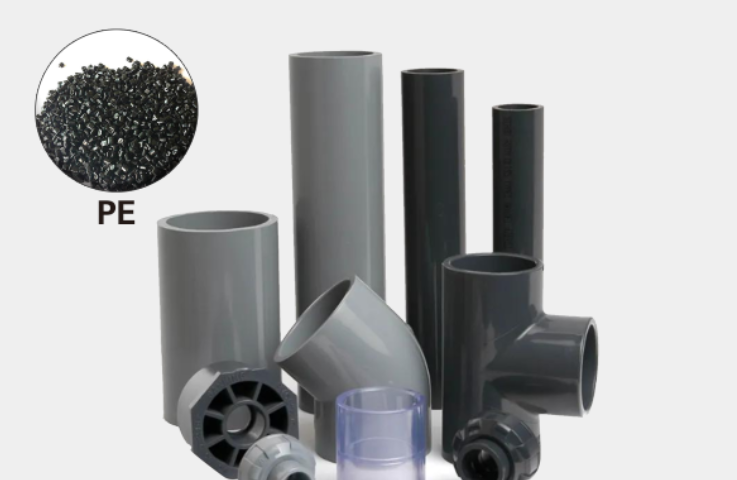
1. Polyethylene (PE)
Divided into low-density (LDPE), high-density (HDPE), and linear low-density (LLDPE), it's one of the most widely used general plastics.
Advantages:
Strong chemical stability, resistant to most acids and alkalis.
Excellent flexibility, LDPE is suitable for making films.
Good processability, can be formed via blow molding, injection molding, etc.
Low cost, suitable for large-scale production.
Disadvantages:
Poor heat resistance, HDPE's long-term use temperature is only about 80°C.
Insufficient mechanical strength, limited load-bearing capacity.
Weak weather resistance, prone to aging under long-term UV exposure.
2. Polypropylene (PP)
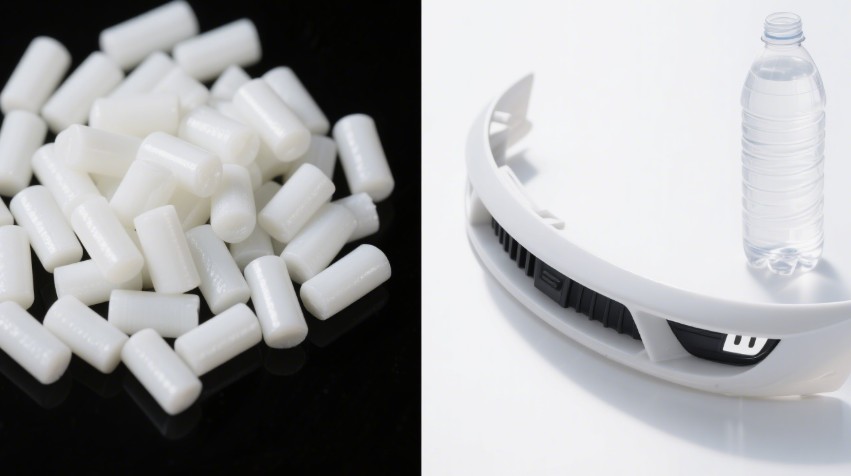
A lightweight, high-strength general plastic, widely used in food packaging and auto parts.
Advantages:
Outstanding heat resistance, normal use temperature is 100 - 120°C, higher with modification.
Good chemical stability, resistant to most chemicals.
Balanced mechanical properties, better strength and rigidity than PE.
Low density (0.90 - 0.91g/cm3), reduces product weight.
Good recyclability, meets environmental requirements.
Disadvantages:
Obvious low-temperature brittleness, easy to crack below 0°C.
Poor resistance to organic solvents, prone to swelling.
Large molding shrinkage (1 - 2.5%), difficult to control dimensional accuracy.
3. Polyvinyl Chloride (PVC)
Can be made into hard and soft forms by adjusting plasticizer content, a cost-effective general plastic.
Advantages:
Low price, significant cost advantage.
Strong chemical corrosion resistance, suitable for chemical equipment manufacturing.
Wide application range, hard PVC for profiles, soft PVC for films and cable sheaths.
Better flame retardancy than most general plastics.
Disadvantages:
Poor thermal stability, decomposes to produce hydrogen chloride above 160°C during processing.
Soft PVC with plasticizers has environmental risks, restricted in food contact applications.
Produces toxic gases and thick smoke when burning, insufficient safety.
4. Polystyrene (PS)
Divided into general-grade (GPPS) and high-impact-grade (HIPS), a typical transparent plastic.
Advantages:
High transparency (light transmittance over 90%), beautiful appearance.
Good processability, short molding cycle, suitable for mass production.
Excellent electrical insulation, suitable for electronic parts.
Low cost, high cost performance.
Disadvantages:
Poor impact resistance, brittle and easy to break.
Poor heat resistance, use temperature not exceeding 70°C.
Prone to static electricity, adsorbs dust and affects use.
5. Polyethylene Terephthalate (PET)
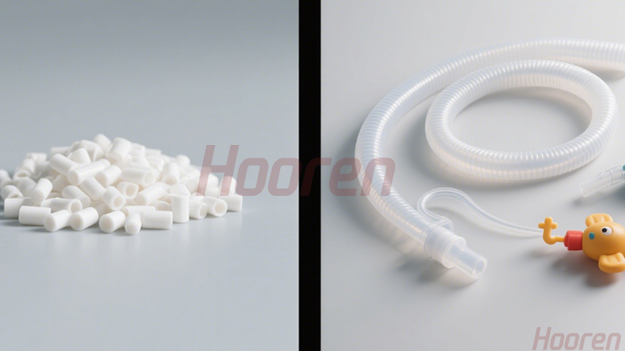
One of the most widely used packaging plastics currently.
Advantages:
High transparency and gloss, beautiful product appearance.
Good gas barrier property, extends food shelf life.
Balanced mechanical properties, combines strength and toughness.
High recycling rate, accounts for over 30% of the global plastic packaging market.
Disadvantages:
Low heat distortion temperature (70 - 80°C), unsuitable for high-temperature use.
Prone to hydrolysis in high-temperature and high-humidity environments, performance declines.
May release trace harmful substances when heated repeatedly.
6. Acrylonitrile - Butadiene - Styrene Copolymer (ABS)
An engineering plastic with excellent comprehensive properties, combining the advantages of three monomers.
Advantages:
Good comprehensive properties, balanced strength, rigidity and impact resistance.
Excellent processability, can form complex structural products.
High surface gloss, easy for painting, electroplating and other surface treatments.
Good dimensional stability, easy to control accuracy.
Disadvantages:
Average heat resistance, long-term use temperature 80 - 100°C.
Poor weather resistance, prone to aging and fading under UV irradiation.
Higher cost than general plastics, restricts low-cost applications.
7. Polycarbonate (PC)
A typical high-strength transparent engineering plastic, widely used in high-end fields.
Advantages:
Extremely strong impact resistance, 250 times that of ordinary glass.
High transparency (light transmittance over 90%), excellent optical properties.
High heat distortion temperature (130 - 140°C), good heat resistance.
Excellent dimensional stability, suitable for precision parts manufacturing.
Disadvantages:
Difficult to process, requires high-temperature and high-pressure molding, high equipment requirements.
Weak chemical resistance, prone to stress cracking under organic solvent erosion.
Expensive, 3 - 5 times that of general plastics.
Factors Affecting Material Selection
1. Usage Environment
Temperature: Prioritize PP and PC for high-temperature scenarios; avoid PP in low-temperature environments, use low-temperature
resistant modified materials.
Chemical Medium Contact: Prioritize HDPE and PVC for chemical scenarios, avoid materials with poor chemical resistance like PC and PS.
Humidity: Use PC and PBT with caution in high-humidity environments, recommend moisture-proof materials like PP and PE.
2. Mechanical Property Requirements
Strength and Rigidity: Prioritize PA and POM for structural parts; avoid PE and PS for load-bearing parts.
Impact Resistance: Prioritize PC and ABS for protective products; use PS and ordinary PP with caution in collision-prone scenarios.
3. Appearance Requirements
Transparency: Choose PET, PC and PS for highly transparent products; choose PS with higher cost performance for general
transparency requirements.
Surface Treatment: Prioritize ABS for products requiring painting and electroplating; any coloring of pure-color products can be
achieved through masterbatch.
4. Cost Factors
Material Cost: Choose PE, PP and PS for low-cost scenarios; choose ABS, PC and PA for high-performance requirements.
Processing Cost: Prioritize ABS and PP with good processability for complex structures; choose PE to reduce costs for simple products.
5. Environmental Requirements
Recyclability: Prioritize easily recyclable materials such as HDPE (recovery rate over 90%) and PP.
Biodegradation: Recommend biodegradable plastics such as PLA for disposable products to reduce environmental pollution.
Conclusion
In custom plastic product manufacturing, material selection needs to comprehensively weigh factors such as usage environment,
performance requirements, cost and environmental protection. General plastics (PE, PP, PVC, etc.) are suitable for low-cost and
ordinary performance scenarios; engineering plastics (ABS, PC, PA, etc.) are suitable for high-performance and high-reliability
requirements. By accurately matching material properties with actual needs, the balance of product quality, cost and environmental
protection can be achieved. In the future, with the development of modification technology and bioplastics, the material selection
for custom plastic products will be more diverse and environmentally friendly.