Plastic Mold Customization: From DFM to Mass Production
The core of plastic mold manufacturing lies in the precise matching of material properties and processing techniques,
which directly determines the mold's service life, molding accuracy, and production costs. Different application scenarios
have significantly varying requirements for molds, requiring a complete technical closed-loop from material selection to
process combination.
1. Matching Mold Steel Selection with Product Characteristics
For ordinary daily necessities molds, P20 steel, after pre-hardening treatment (HRC28-32), can meet the needs of up to 300,000
molding cycles. Its excellent machinability reduces CNC processing time by 50%. Molds for automotive structural parts, which
need to withstand high-frequency injection molding and erosion from glass fiber-reinforced materials, use H13 steel. After
quenching and tempering (HRC48-52), combined with nitriding treatment to form a 0.1-0.3mm hardened layer, their service life
can exceed 1 million cycles. For precision electronic parts molds, NAK80 pre-hardened steel is preferred. It can ensure a hardness
of HRC38-42 without post-heat treatment, and the processed surface roughness can reach Ra0.05μm, meeting the requirements
of mirror molding.
2. Combination Strategies for Processing Techniques
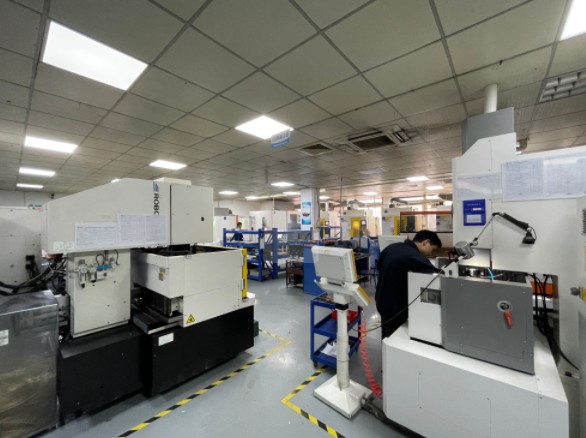
The main molding of the cavity relies on 5-axis CNC machining, whose positioning accuracy of ±0.003mm and repeat positioning
accuracy of ±0.001mm ensure the dimensional consistency of complex curved surfaces. Hard-to-machine areas such as deep cavities
and narrow slots require electrical discharge machining (EDM). Through pulse discharge of copper electrodes, it achieves micron-level
precision control, with surface roughness up to Ra0.02μm, suitable for high-gloss product molding. Special structures like irregular
slider grooves and inclined top guide holes use wire electrical discharge machining (WEDM), which has a machining accuracy of
±0.002mm and perpendicularity of ≤0.005mm/m, ensuring smooth cooperation of moving parts.
3. Performance Optimization through Heat Treatment
H13 steel undergoes 860℃ vacuum quenching + 580℃ tempering twice to eliminate internal stress and form a uniform martensite
structure, improving thermal fatigue resistance by 40%. The pre-hardening treatment of P20 steel adopts a "stepwise heating + constant
temperature holding" mode, with 2-hour insulation at every 100℃ interval between 200-500℃ to avoid deformation due to excessive
temperature differences. As the final process, nitriding requires controlling the process temperature at 520℃ and holding time for 20
hours to ensure the compound layer thickness is 5-10μm, which enhances surface hardness without affecting the matrix toughness.
4. Dynamic Adjustment of Process Parameters
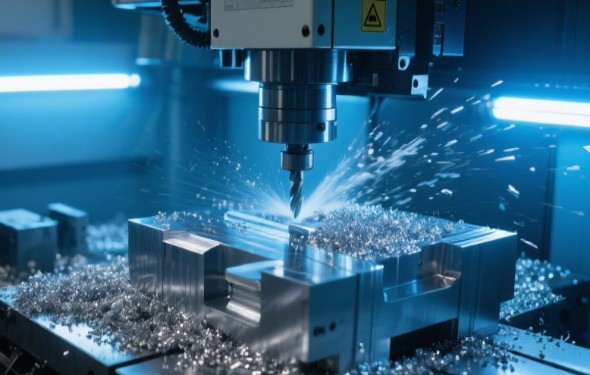
When processing P20 steel, the CNC cutting speed can be set to 80-100m/min, with a feed rate of 0.1-0.15mm/r to avoid built-up edge
caused by excessive speed. For EDM of H13 steel, the pulse current needs to be reduced to 3-5A, and the discharge gap increased to
0.03-0.05mm to reduce heat accumulation during processing. The polishing process for NAK80 steel must follow the "from coarse to
fine" principle: sequentially using 400#, 800#, and 1200# sandpaper for grinding, and finally polishing with a wool wheel and diamond
paste to achieve a mirror finish while avoiding surface scratches.
5. Trial Molding Verification and Continuous Optimization
During trial molding, it is necessary to record the molding parameters of different materials: for ABS, the mold temperature should
be controlled at 50-60℃, and the holding pressure should be 70% of the injection pressure; for PC, the mold temperature needs to
be increased to 120-140℃, and the holding time extended to 15-20 seconds. Adjust the mold structure based on trial results: if local
wear is excessive, replace the insert material in the corresponding area; if cooling is uneven, optimize the water channel layout to
ensure the temperature difference between cavity areas is ≤5℃.
The technical challenge in plastic mold manufacturing is finding a balance between material performance, processing accuracy,
and production costs according to product requirements. Only by deeply integrating material characteristics with process capabilities
can high-quality molds that meet both usage requirements and economic efficiency be manufactured.