Quality defects and solutions of precision injection molding products
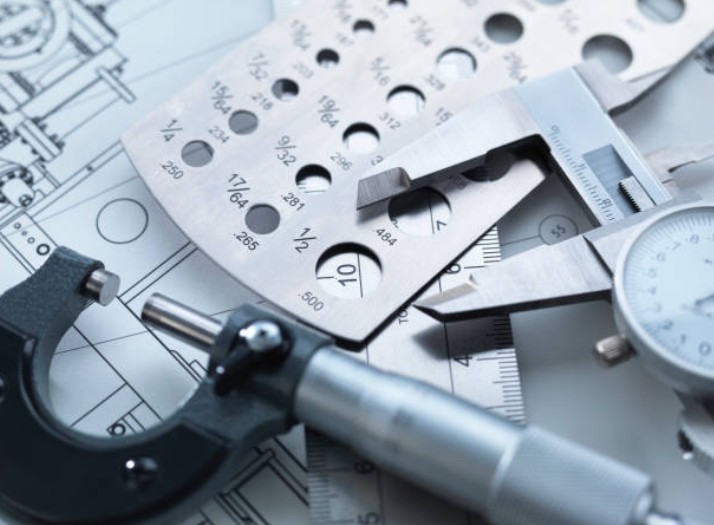
Problem Performance: Critical dimensions exceed the preset tolerance (such as ±0.01mm), directly affecting the assembly accuracy of components and possibly leading to the failure of the entire machine.
Cause Analysis: Insufficient stability of the injection molding machine's metering system, with barrel temperature fluctuations exceeding ±1℃; uneven distribution of the mold's temperature field, resulting in significant differences in shrinkage during the cooling stage; unreasonable setting of pressure-holding parameters, leading to poor replenishment effect.
Countermeasures: Use a closed-loop control injection molding machine equipped with a 0.01mm-level displacement sensor to calibrate the injection volume deviation in real-time; upgrade the temperature control system to PID + fuzzy control to compress barrel temperature fluctuations within ±0.5℃; configure a multi-zone mold temperature controller to ensure that the temperature difference between each area of the cavity is ≤0.5℃; optimize the cooling curve according to material characteristics (for example, PC materials need 30% longer cooling time) and achieve precise temperature control with infrared temperature measurement.
Sinks and Depressions
Problem Performance: Local indentations appear at the transition of wall thickness, which not only affects the appearance but may also become stress concentration points.
Cause Analysis: Insufficient pressure-holding pressure or time, resulting in untimely melt replenishment; improper design of gate position, leading to excessive pressure loss due to too long melt flow path.
Countermeasures: Implement a stepwise pressure-holding process (initial 80% of rated pressure, reduced to 60% after 3 seconds) and dynamically adjust through pressure feedback; use CAE mold flow analysis to optimize gate layout, controlling the maximum flow distance within 50mm; adopt conformal cooling water channels in thick-walled areas (>3mm) to accelerate local solidification speed.
Silver Streaks and Bubbles
Problem Performance: Silver-white streaks on the surface or bubbles inside, which are particularly common in hygroscopic materials such as PA and PC.
Cause Analysis: Excessive moisture content in raw materials (>0.02%), generating water vapor at high temperatures; too fast injection speed leading to incomplete exhaust of the cavity and entrainment of air to form bubbles.
Countermeasures: Use a dehumidifying and drying system with a dew point ≤-40℃, and set drying parameters according to material characteristics (for example, PA66 requires 4-6 hours); adopt three-stage injection speed control (low speed in the gate section, medium speed in the main runner section, and high speed at the end of the cavity), and set 0.01-0.02mm deep micro 排氣槽 on the parting surface.
Flash and Burrs
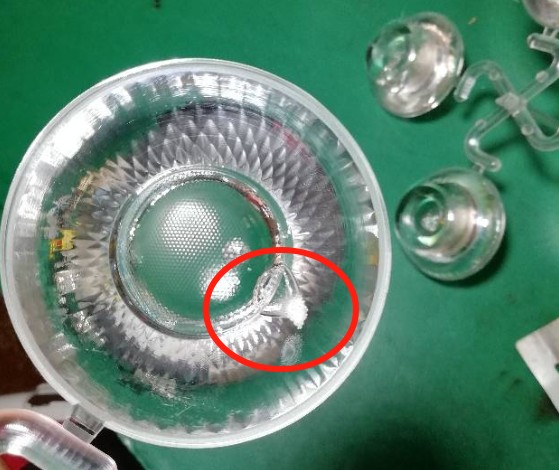
Problem Performance: Excess material edges appear on the mold mating surface, requiring additional trimming processes, increasing costs and possibly affecting assembly.
Cause Analysis: Insufficient or uneven clamping force, leading to mold sealing failure; long-term use resulting in mold mating gap exceeding 0.005mm.
Countermeasures: Regularly detect the clamping force fluctuation value to ensure it is ≤±2%, and replace the high-precision servo valve if necessary; use a laser diameter gauge to monitor the mold gap, and repair worn parts to ≤0.003mm by electrical discharge machining; appropriately reduce the injection pressure by 10-15% for high-viscosity materials such as POM.
Weld Lines
Problem Performance: Obvious seams form at the confluence of melt splits, with strength 20-30% lower than the main body.
Cause Analysis: The temperature of the melt drops by more than 15℃ when converging, resulting in insufficient diffusion and fusion of molecular chains; poor exhaust of the cavity, with accumulated gas hindering melt combination.
Countermeasures: Add heating rods (temperature 5-10℃ higher than the barrel) at the weld line position to increase the local melt temperature; adopt sequential valve gating technology to control the opening time difference of each gate to ≤0.5 seconds; set 1 exhaust slot per 100mm circumference, with the depth of the exhaust slot for ABS materials ≤0.015mm.
Warpage and Distortion
Problem Performance: The product bends or twists after demolding, with straightness deviation exceeding 0.1mm/m, affecting assembly accuracy.
Cause Analysis: Excessive difference in molecular orientation (shrinkage difference between flow and vertical directions >2%); uneven mold cooling causing internal stress concentration.
Countermeasures: Use a rotating screw (rotational speed fluctuation ≤5rpm) to reduce melt shear stress; identify high-stress areas through mold flow analysis and set stress relief slots; adopt a slow cooling process for crystalline materials such as POM to control the cooling rate difference ≤5℃/s.
Strength Reduction
Problem Performance: The mechanical properties of the product decrease, with tensile strength 15% lower than the standard value, making it prone to fracture.
Cause Analysis: Uneven plasticization (unmelted particles accounting for >3%); too fast injection speed leading to molecular chain breakage; excessive proportion of recycled materials (>20%) or too many impurities.
Countermeasures: Replace with a barrier screw to improve plasticization effect, ensuring that the melt temperature distribution difference is ≤3℃; use servo drive to control the injection acceleration ≤50mm/s2; monitor the purity of raw materials through an online near-infrared detection system, and filter recycled materials through a 100-mesh filter before adding.